

Disclosure: As an Amazon Associate, we earn from qualifying purchases.
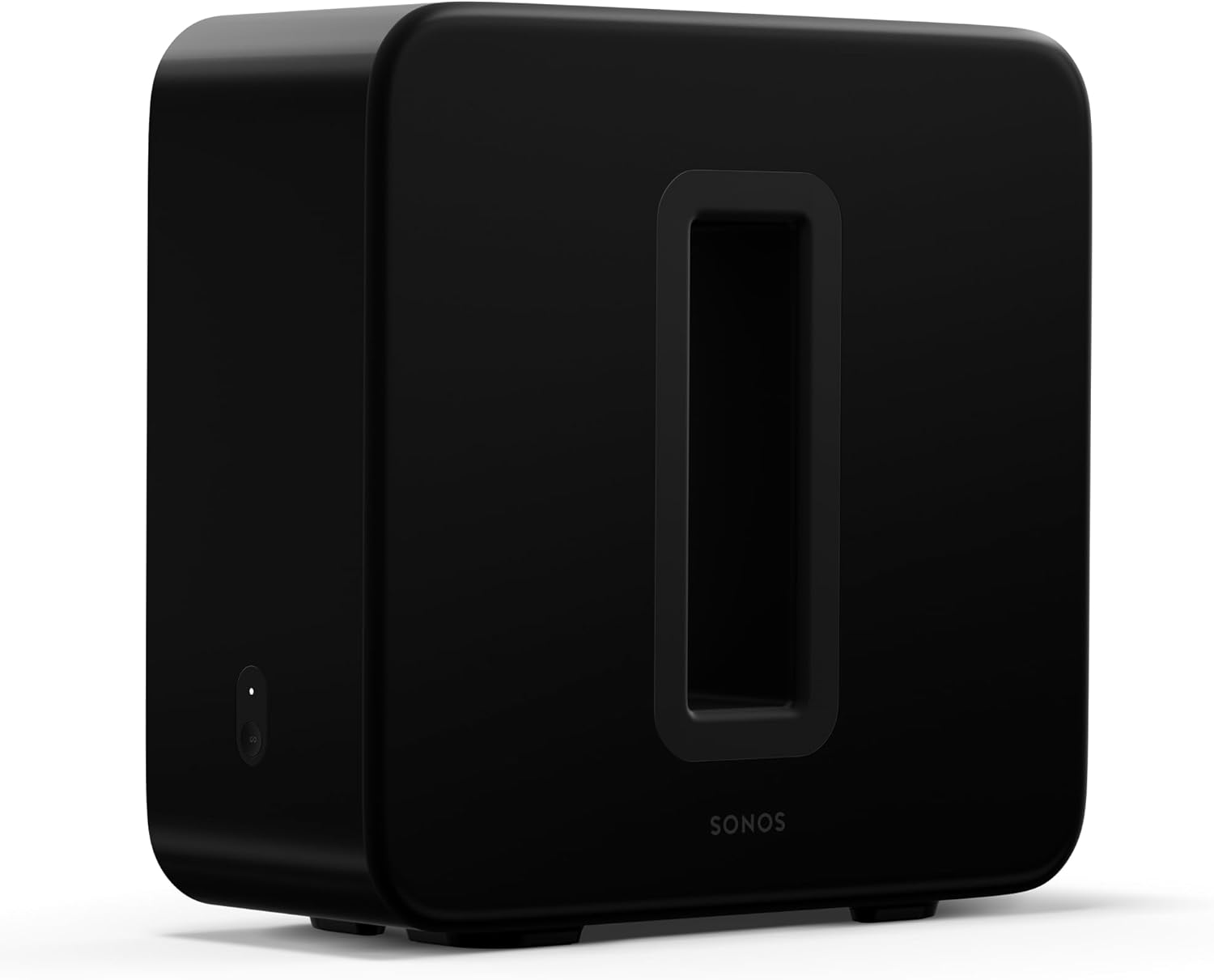
The Sonos Sub (Gen 3) is Sonos’s $799 flagship subwoofer — two force-cancelling drivers face-to-face in a sculptural cabinet, tuned to dig down to 25 Hz. It exists to answer one question: is the biggest bass Sonos makes worth double the price of the Sub Mini? For most rooms, the honest answer is no — but the Sub Gen 3 has a clear constituency, and this page draws the line precisely.
This is a decision guide, not a spec sheet. We haven’t measured the Sub Gen 3 in a listening room — everything below comes from Sonos’s published specifications and documented features. For the smaller, cheaper sibling, see our compatibility matrix for which subs pair with which soundbars.
The quick verdict
Buy it if: you run an Arc Ultra or Arc in a medium-to-large room and want home-theater bass you feel, or you’re building a dual-sub setup with a large soundbar. It also frees your paired speakers’ midrange by offloading all low frequencies.
Skip it if: your room is small, your neighbors share a wall, or you’re pairing with a Beam Gen 2 / Beam Ultra — the $429 Sub Mini covers those cases for nearly half the price.
Sub Gen 3 vs Sub Mini: the real decision
These two subs are the whole buying decision for most Sonos owners. Here’s the honest breakdown:
| Sub (Gen 3) | Sub Mini | |
|---|---|---|
| Price (Sonos US) | $799 | $429 |
| Bass extension | Down to 25 Hz | Less deep — the Mini trades low-end reach for size |
| Drivers | Two force-cancelling drivers, two Class-D amps | Two force-cancelling woofers, smaller cabinet |
| Footprint | Large sculptural cabinet (~16″ × 15.3″ × 6.2″) | Compact cylinder — fits where the Gen 3 can’t |
| Best paired with | Arc Ultra, Arc, Beam Ultra in medium–large rooms | Beam Gen 2, Beam Ultra, Ray, small rooms |
| Trueplay | iOS-only Trueplay | iOS-only Trueplay |
| Bluetooth | No (Wi-Fi / Ethernet only) | No (Wi-Fi only) |
| Dual-sub support | Yes — two subs with Arc/Arc Ultra/Beam Ultra-class bars | Yes — two Minis allowed on the same bars |
Specs from Sonos’s published documentation and spec aggregators; price figures are Sonos’s US list prices. The Mini-vs-Gen-3 recommendation comes from room physics and Sonos’s own pairing guidance, not from listening tests.
Who the Sub Gen 3 is for
- Arc Ultra / Arc owners in medium-to-large rooms. Big bars in big rooms need the big sub — the Sub Mini runs out of headroom filling a large space. Confirm your room size in our room-size planning guide.
- Movie-first systems. The 25 Hz extension is for explosions, not background music — if home theater is the primary use, the Gen 3 earns its premium.
- Dual-sub builders. Sonos allows two subs bonded to a single soundbar for large rooms — the Gen 3 is the flagship half of that configuration.
- Music listeners who want full-range sound from a soundbar. Offloading bass to the sub lets the bar’s midrange breathe — the pairing works across the whole Sonos soundbar line. Check the compatibility matrix.
Who should skip it
- Apartment dwellers. 25 Hz bass in an apartment is a neighbor-relations decision, not a sound decision. Our Sonos for apartments guide covers the quieter options.
- Beam Gen 2 / small-room owners. The Sub Mini is the matched partner here — the Gen 3’s extra output is wasted in a small space and the Mini’s smaller footprint fits better.
- Music-only systems with Era speakers. A single Era 300 or stereo Era 100s as music speakers often don’t need a sub at all — and if they do, the Mini is the proportionate choice.
- Budget system builders. The sub is the single most common place to overspend in a Sonos system. Two hundred dollars of room treatment via our Trueplay guide thinking costs nothing and matters more than the last few Hz.
Three mistakes Sub buyers make
- Buying the flagship sub for a small room. Bass output doesn’t scale down gracefully — an oversized sub in a small room booms, not sings. The Sub Mini exists for exactly these rooms.
- Assuming any sub fixes muddy dialogue. Dialogue clarity comes from the bar and its Speech Enhancement, not from more bass. If voices are unclear, see our three-way soundbar comparison instead.
- Skipping Trueplay after adding the sub. The sub changes the room’s bass behavior — re-run Trueplay (iOS) after adding it. When tuning fails, our Trueplay troubleshooting guide covers the fixes.
What to pair it with
- Arc Ultra / Arc: the canonical pairing — big soundbar, big sub, and a pair of Era 300 or Era 100 surrounds for the full system.
- Beam Ultra in large rooms: the Gen 3 gives the Ultra-class bar real theater bass; in small rooms, prefer the Sub Mini.
- Two subs: for very large rooms, Sonos supports bonding two Sub Gen 3s (or two Sub Minis — don’t mix) to one soundbar.
- Don’t pair: Era 300 surrounds are overkill on a Beam Gen 2 — match the sub and surrounds to the bar, not to each other. The compatibility matrix lays out every valid combination.
The honest limits of this guide
We have not set up or measured the Sub Gen 3 in a room. This guide synthesizes Sonos’s published specifications and documented features — it is a planning resource, not a review. Bass-room interaction varies enormously by room; our room-size planner is the best tool for sizing a sub to your space.
Check the current price on Amazon →
Frequently asked questions
Sub Gen 3 vs Sub Mini — which should I buy?
Large room + Arc-class bar: Gen 3. Small-to-medium room or Beam-class bar: Sub Mini, and it’s nearly half the price. The Mini isn’t a compromise in the right room — it’s the matched product.
Can I use two Sub Gen 3s with one soundbar?
Yes — Sonos supports dual subs bonded to Arc, Arc Ultra, Beam Gen 2, and Beam Ultra. Don’t mix a Gen 3 with a Mini in one system.
Does the Sub Gen 3 have Bluetooth?
No. It connects over Wi-Fi or Ethernet and is controlled through the Sonos app.
Will the Sub Gen 3 work with any Sonos speaker?
It bonds with Sonos soundbars and many Sonos speakers via the S2 app — see the compatibility matrix for the full rules.
Can I stand it upright or lay it flat?
Both — the cabinet is designed for vertical or horizontal placement. Bass is non-directional, so placement is flexible.
Disclosure: As an Amazon Associate, we earn from qualifying purchases.
